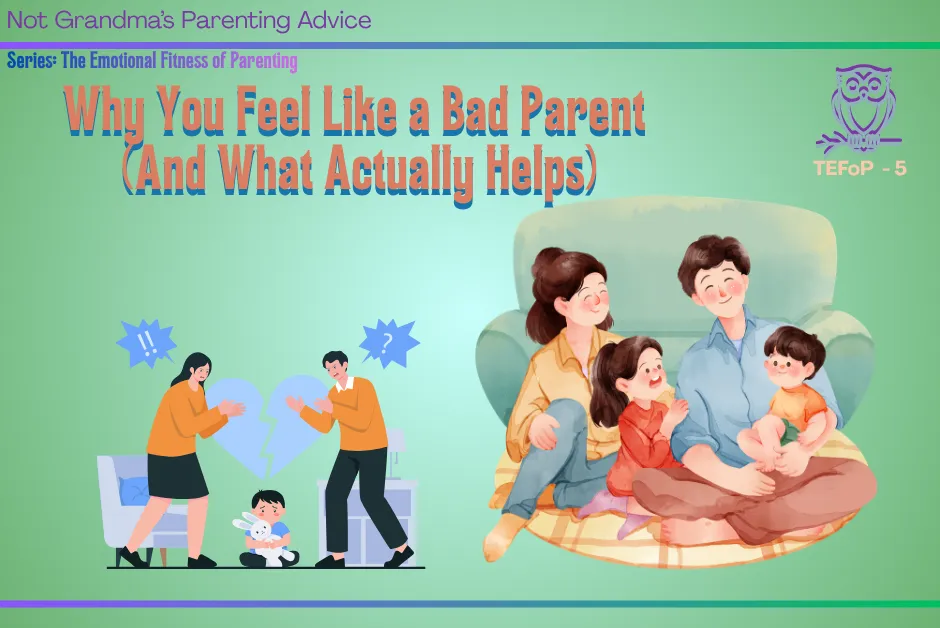
Why You Feel Like a Bad Parent (And What Actually Helps)
Shame, Self-Talk & Repair
Why what you say to yourself matters more than you think
There’s a moment that many parents don’t talk about.
It doesn’t happen during the reaction.
It happens after.
You’ve snapped.
Raised your voice.
Handled something in a way you wish you hadn’t.
And then, quietly, the voice begins.
“I shouldn’t have done that.”
“I know better than this.”
“What’s wrong with me?”
It can be subtle.
Or it can be loud.
But it shapes everything that comes next.
The part we often miss
In this work, we talk a lot about how we respond to our children.
How we:
regulate
pause
repair
But there’s another layer that often goes unseen.
How we respond to ourselves.
Because after a difficult moment, there are two paths:
You move into shame…
or you move into repair.
What shame actually does
Shame doesn’t motivate change.
It shuts it down.
When the internal message becomes:
“I am a bad parent”
“I always get this wrong”
“I should be better”
Something important happens.
You stop learning.
Because shame turns a behaviour into an identity.
Not:
“I didn’t handle that well”
But:
“There’s something wrong with me”
And when identity is threatened, the brain moves into protection.
Defensiveness.
Justification.
Avoidance.
Not growth.
Where this voice comes from
This internal voice doesn’t appear out of nowhere.
It’s often shaped by:
how we were spoken to
what we learned about mistakes
how repair (or lack of it) was modelled
For many, the message was:
“Get it right.”
“Don’t make mistakes.”
“Be better.”
So when we become parents, that same voice turns inward.
Not because we want it to.
But because it’s familiar.
The role of Emotional Fitness
From an Emotional Fitness perspective, this voice is not random.
It’s part of what Joe Pane describes as our internal saboteurs.
Predictable patterns that show up under pressure.
Not to help us grow —
but to try and keep us safe.
The problem is, they often keep us stuck.
Because instead of guiding us forward…
They keep us focused on what’s wrong.
The shift from shame to responsibility
This work is not about removing responsibility.
It’s about changing how we relate to it.
There is a big difference between:
“I am a bad parent”
and
“I didn’t handle that well”
One creates shame.
The other creates space.
And in that space, something becomes possible:
Reflection.
Learning.
Change.
Repair begins with you
We often think of repair as something we do with our child.
And it is.
Coming back.
Acknowledging what happened.
Reconnecting.
But repair also needs to happen internally.
Because if you are harsh with yourself…
You will either:
avoid repair with your child
or attempt it from a place of guilt rather than clarity
Neither creates safety.
When you can say to yourself:
“That wasn’t how I wanted to show up… and I can do this differently”
You remain open.
And from that place, repair becomes real.
What children learn from repair
From a Circle of Security perspective, children don’t need perfection.
They need:
Rupture…
and repair.
They need to experience that:
relationships can stretch
things can go wrong
and connection can be restored
When you repair with your child, you are teaching:
“I can make mistakes and still be loved”
“I can feel big emotions and still be safe”
“I can come back from this”
But that teaching only lands…
If you believe it for yourself first.
Becoming safer for yourself
This is the part that often gets overlooked.
The way you speak to yourself
becomes the emotional environment you parent from.
If your internal world is:
critical
harsh
unforgiving
That tone will find its way into your relationships.
Not intentionally.
But inevitably.
When you become safer for yourself:
more understanding
more compassionate
more reflective
You naturally become safer for your child.
Not because you’re trying harder.
But because your baseline has changed.
A different way forward
After a difficult moment, try this:
Instead of:
“What’s wrong with me?”
Ask:
“What happened there?”
Instead of:
“I should be better”
Try:
“What would I like to do differently next time?”
Instead of:
“I always get this wrong”
Notice:
“That was a hard moment”
These are small shifts.
But they change the direction entirely.
This is Emotional Fitness in practice
Emotional Fitness is not about eliminating mistakes.
It’s about what happens after them.
Do you shut down…
or stay open?
Do you criticise…
or reflect?
Do you avoid…
or repair?
Because every moment of repair — with yourself and your child — builds something stronger than perfection ever could.
A gentle next step
This week, notice your self-talk.
Not to judge it.
Just to hear it.
Because awareness is the beginning of change.
And from there, you can begin to choose something different.
If this resonates, you’re not alone.
This is the work I support parents through — helping them move from self-criticism into self-awareness, and from reactivity into relational leadership.
As always – Together we ARE Stronger
Regards
Leanne
The Motherhood Maven
Parenting Mentor | Emotional Fitness Consultant


