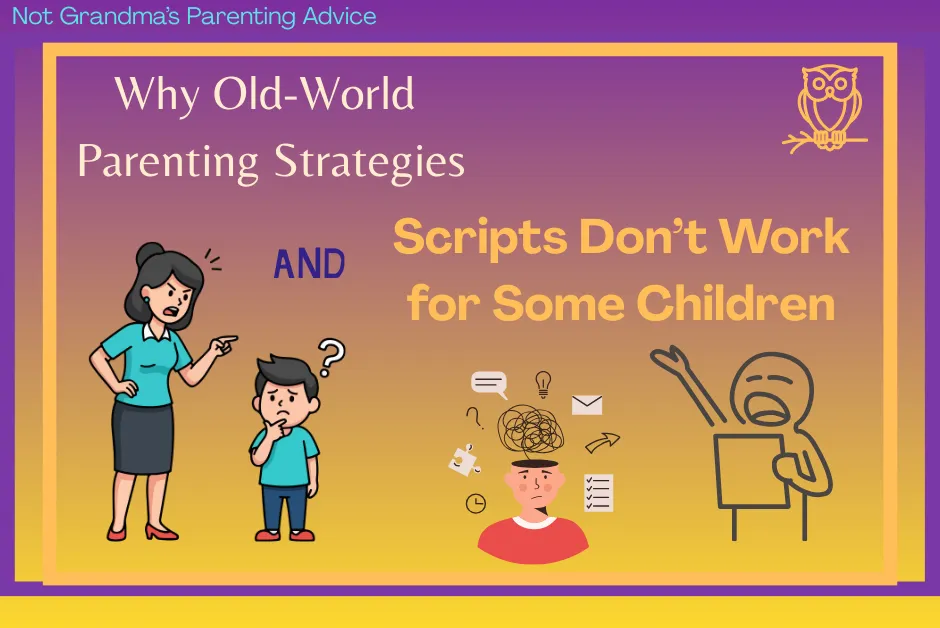
Why Old-World Parenting Strategies and Scripts Don’t Work for Some Children
Why Old-World Parenting Strategies and Scripts Don’t Work for Some Children
(And Why That’s Not Your Fault)
There is a quiet grief many parents carry — especially mothers.
It sounds like this:
“I read the books.”
“I tried the scripts.”
“I stayed calm.”
“I did what the experts said.”
“Why didn’t it work for my child?”
For parents raising neurodivergent or emotionally intense children, that question often turns inward and hardens into shame.
But here’s the truth I wish someone had told me much earlier:
Parenting strategies don’t fail because you applied them incorrectly.
They fail when a child’s emotional security needs are misunderstood.
The promise of parenting scripts — and where they quietly break down
Most parenting books are written with an unspoken assumption:
That the child already feels safe enough, settled enough, and understood enough to process what the parent is saying.
Scripts such as:
“I won’t let you hit, but I’m here with you.”
“You can be angry, but you still need to listen.”
“Let’s take some deep breaths.”
These are not bad strategies.
In fact, they can be helpful — when the child’s emotional alarm system is not already activated.
But when a child feels overwhelmed, threatened, misunderstood, or emotionally unsafe, a very different process is occurring in their brain.
The amygdala — the brain’s early warning system — is activated.
Its job is to scan for danger, not to listen, reason, or cooperate.
When that alarm is switched on, the thinking part of the brain goes offline.
At that point, language doesn’t land as guidance.
It lands as noise.
My lived experience (and perhaps yours too)
I remember trying to “do it right”.
I had the words.
I understood the theory.
I genuinely wanted to parent differently from how I was raised.
And yet — the more I tried to apply the strategies, the more chaotic things sometimes felt.
Some days I was calm and connected.
Other days I was reactive, controlling, or completely exhausted.
And the hardest part?
I blamed myself.
I assumed:
I wasn’t consistent enough
I wasn’t patient enough
I wasn’t calm enough
I wasn’t doing the work “properly”
What I didn’t understand then was this:
I was trying to use strategies designed for emotionally secure moments during times when my child did not yet feel emotionally safe.
No script can work when a child’s internal alarm is still blaring.
Why strategies don’t land for some children (and why that matters)
For many neurodivergent or emotionally intense children, the challenge isn’t discipline.
It’s emotional safety.
Here are three common reasons parenting strategies fail to land — none of which are a reflection of poor parenting.
1. The child doesn’t yet feel emotionally secure in the moment
When a child perceives threat — whether that threat is sensory overload, emotional pressure, misunderstanding, or loss of control — their amygdala is activated.
In this state:
they cannot access logic
they cannot process instructions
they cannot reflect on consequences
they cannot “choose better”
No amount of calm language can override an active alarm system.
Before learning can occur, the child needs to feel safe again.
2. The child’s experience is being misunderstood
Many children — particularly those with ADHD, PDA traits, sensory sensitivities, or high emotional reactivity — experience the world more intensely.
What appears to be “overreacting” is often a child responding to:
cumulative overwhelm
sensory saturation
emotional pressure
feeling rushed or controlled
feeling unseen or misunderstood
When a child feels misunderstood, their emotional security weakens.
And when emotional security weakens, behaviour escalates — not because the child is difficult, but because their internal system is trying to protect them.
3. The parent is being asked to override their own humanity
Many parenting approaches unintentionally place an unrealistic demand on parents — particularly mothers.
They ask you to:
remain calm on demand
respond perfectly while exhausted
regulate everyone else while suppressing your own feelings
apply scripts regardless of context
carry the emotional load without support
This doesn’t reduce stress — it increases it.
And when parents are stretched thin, emotional safety erodes for everyone in the household.
This isn’t a discipline problem — it’s a misunderstanding problem
Old-world parenting advice often suggests:
“If the strategy didn’t work, you need to be more consistent.”
But when neurodivergence or emotional intensity is part of the picture, the issue is rarely effort.
It’s misunderstanding.
A misunderstanding between:
behaviour and emotional need
expectation and capacity
compliance and security
instruction and readiness
When we stop trying to manage behaviour and start trying to understand the child, everything shifts.
Not instantly.
But fundamentally.
What helps instead: calming the alarm before teaching the lesson
Instead of asking, “What should I say right now?”, try shifting to:
“Does my child feel safe enough to hear me?”
“What might have triggered their emotional alarm?”
“What do they need to feel understood first?”
“What support do I need so I don’t escalate too?”
When emotional security is restored, the amygdala settles.
When the alarm quietens, thinking returns.
Only then do strategies, guidance, and learning have somewhere to land.
This is the essence of emotional fitness — not controlling behaviour, but creating the conditions in which growth becomes possible.
If you’re feeling discouraged, this part matters
If you’ve tried everything and nothing seems to stick, please hear this clearly:
You didn’t fail the strategies.
The strategies were applied before your child felt emotionally safe enough to use them.
There is another way to parent — one that doesn’t rely on scripts, perfection, or constant self-control.
It begins with understanding.
It reduces emotional load rather than adding to it.
And it supports both the child and the parent.
I’ll be sharing more about this approach as we move toward February.
For now, know this:
You are not alone.
You are not behind.
And you are not failing.
Regulated homes create resilient kids —
and emotional security is where regulation truly begins.
Together we ARE Stronger
Regards
Leanne
The Motherhood Maven
Parenting Mentor | Emotional Fitness Consultant


