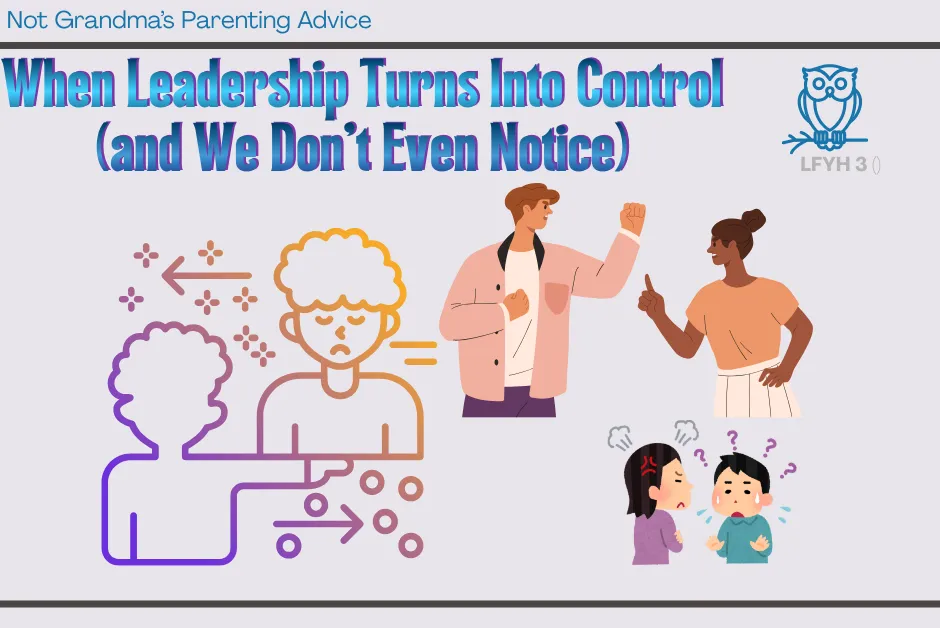
When Leadership Turns Into Control (and We Don’t Even Notice)
When Leadership Turns Into Control (and We Don’t Even Notice)
Most parents don’t set out to be controlling.
In fact, the parents I work with are usually the opposite.
They’re thoughtful, reflective, and deeply committed to doing better than what they experienced themselves.
They read the books.
They listen to the podcasts.
They try the strategies.
And still, something feels tense at home.
The kids push back.
The partner resists.
Everyone seems a little on edge.
And underneath it all is a quiet question:
Why does it feel like I’m holding everything together on my own?
Control often grows out of care
Control doesn’t usually come from harshness.
It grows out of concern.
You want your child to:
feel safe (physically and emotionally)
develop confidence in alignment with their design and temperament
learn emotional intelligence (it takes time and is the only learnable intelligence)
avoid the pain you experienced
So you pay attention.
You think ahead.
You try to get things “right”.
Your expand your own anxiety (the desire to control the future) with no conscious intention.
But under pressure, we always default to our automatic programming. Despite desires to be different that care can slowly turn into control.
More reminding.
More correcting.
More “just do it this way”.
Not because we want to be authoritarian, but because our own internal voice, that shark music effect (from the well known university study of the impact of music on our ability to focus during a set task.) driving our subconscious mind into survival mode.
We want to be effective and for things to go well., in other words be a good parent. But our childhood programming can override our intentions.
The invisible shift from leadership to management
Leadership and control can look very similar on the surface.
Both involve:
setting boundaries
guiding behaviour
making decisions
holding responsibility
But internally, they feel very different.
Control sounds like:
“They need to do it my way.”
“This will fall apart if I don’t step in.”
“No one else is doing this properly.”
Leadership sounds like:
“What’s really needed here?”
“How can we move forward together?”
“What part of this is actually in my control?”
Control tightens.
Leadership steadies.
Control focuses on behaviour.
Leadership focuses on relationship.
Why control creates resistance
Children, like adults, have an internal need for autonomy.
When they feel constantly directed, corrected, or over-managed, their nervous system often reads it as pressure.
And pressure produces one of three reactions:
push back (fight)
withdraw (flight)
shut down (freeze)
This isn’t because they’re difficult.
It’s because they’re human and no one enjoys feeling “caged”, judged or criticised.
The same thing happens between adults.
When one parent feels corrected, overridden, or micromanaged, cooperation becomes harder — not easier.
Control, even when well-intentioned, tends to:
increase defensiveness
reduce trust
and create quiet resentment
The emotional load of “holding it all together”
Many parents — especially primary carers — carry a heavy invisible load.
You’re thinking about:
routines
emotional wellbeing
school concerns
behaviour patterns
the long-term impact of decisions
So when someone else approaches things differently, it can feel threatening.
Not because they’re wrong.
But because it feels like:
“All the work I’m doing doesn’t matter.”
That feeling can lead to:
correcting your partner in front of the children
stepping in constantly
redoing what others have done
feeling resentful or alone
And over time, this creates distance — not only between partners, but between parent and child.
Leadership starts with releasing what isn’t yours to control
One of the hardest shifts in parenting is this:
Realising that not everything is within your control or your responsibility to in control of.
You can’t:
control your child’s emotions
control your partner’s reactions
control every outcome
What you can lead is:
your own regulation
your responses
the emotional climate you help create
the conversations you initiate later
Leadership is less about directing others in the moment
and more about shaping the direction of the relationship over time.
It’s in the building beautiful foundations than enable cooperation rather than conflict. That empower effective communication and sustainable aligned development.
From correction to consultation
When leadership replaces control, something important changes.
Instead of:
correcting in the moment
taking sides
trying to “win” the interaction
You begin to:
allow space for different styles
process experiences afterwards
invite reflection
collaborate on better solutions
This is true with children.
And it’s just as true with partners.
Because people don’t grow through correction alone.
They grow through:
feeling heard
feeling safe
and being part of the solution
The shift we’re making this week
Leading the family you have isn’t about:
doing everything right
being the calmest person in the room
or getting everyone to agree with you
It’s about noticing the moments where:
care turns into control
fear turns into micromanagement
and leadership quietly disappears.
And then gently choosing a different response.
Not perfectly.
Just consciously.
Because children don’t need perfectly managed homes.
They need homes where adults:
take responsibility for their own choices/actions
repair when things go wrong
and lead with steadiness instead of control
That’s where real emotional safety grows.
If this feels familiar, you’re not alone.
This is a very normal stage in the journey from managing behaviour to leading relationships — and it’s a shift many families find themselves navigating right now.
As always – Together we ARE Stronger
Regards
Leanne
The Motherhood Maven
Parenting Mentor | Emotional Fitness Consultant


