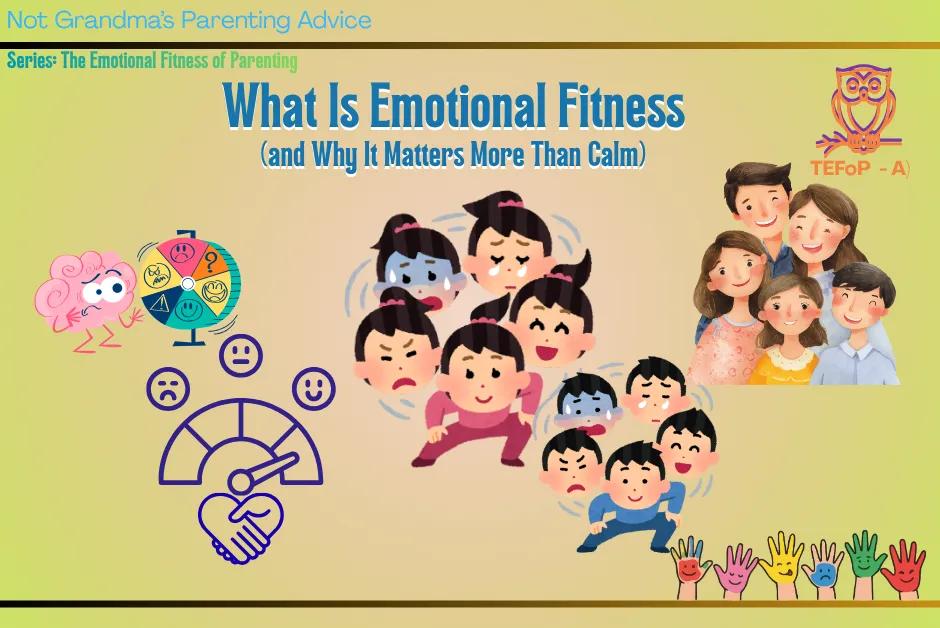
What Is Emotional Fitness (and Why It Matters More Than Calm)
What Is Emotional Fitness (and Why It Matters More Than Calm)
Across the Leading the Family You Have series, we explored what it means to move beyond managing behaviour and into leading relationships at home.
And for many parents, that shift changes everything.
You begin to see behaviour differently.
You pause more.
You understand more.
And at the same time, a new challenge often appears:
“If I know what to do… why is it still so hard to do it consistently?”
This is where we begin the next layer of the work.
Not more strategies.
Not better scripts.
But something deeper.
Emotional Fitness — what it actually means
Emotional Fitness is not about staying calm all the time.
It’s not about getting it right every time.
And it’s definitely not about becoming a perfectly regulated parent.
Emotional Fitness is your capacity to:
stay present when things feel intense
pause instead of react (even briefly)
recover when you do react
repair when disconnection happens
and continue to lead, even when it’s hard
It’s dynamic.
It ebbs and flows.
Some days you’ll have more of it.
Some days you won’t.
And that’s not a problem.
That’s being human.
Why calm is not the goal
Many parents come into this work believing they need to be calmer.
More patient.
More consistent.
More in control.
And while those qualities can be helpful, they’re not the goal.
Because calm disappears under pressure (especially for the ADHDers amongst us).
When you’re tired.
When your child is dysregulated.
When your partner responds differently.
When multiple things are happening at once.
If calm is your goal, you will feel like you’re failing in the moments that matter most.
Emotional Fitness offers a different standard.
Not:
“Did I stay calm?”
But:
“Was I able to come back?”
And that’s where FITNESS sits. It’s about strengthening our capability, so that we have more capacity to “lift the load” when things get messy or chaotic.
The difference between knowing and being able
One of the biggest frustrations for parents is this gap:
“I understand my child now… so why am I still reacting?”
Because understanding is not the same as capacity.
You can:
understand emotional needs
recognise behaviour as communication
know the “right” response
…and still not be able to access that response in the moment.
Especially when you’re:
overwhelmed
triggered
under pressure
or carrying your own emotional load
This is not a mindset problem.
It’s a capacity problem.
And capacity can be developed.
The Circle of Safety — and your role in it
In Raising a Secure Child, the Circle of Security describes the parent as:
Bigger. Stronger. Wiser. Kind.
Not perfect.
Not always calm.
But able to:
hold the space
guide when needed
and reconnect when things go off track
This is Emotional Fitness in practice.
Because to be “bigger, stronger, wiser, and kind” — especially in hard moments — requires capacity.
Not control.
What gets in the way
If Emotional Fitness is so important, why is it so hard?
Because we are human.
We bring:
our own history
our own conditioning
our own stress
our own relationship dynamics
And under pressure, we don’t rise to our intentions.
We fall back to our patterns.
This is where Joe Pane’s Emotional Fitness work is so powerful.
It highlights that:
our reactions are often automatic
our thinking can be influenced by internal “saboteurs”
and our behaviour under pressure is not always aligned with our values
The work is not to eliminate these patterns.
It’s to become aware of them — and gradually build the capacity to respond differently.
Emotional Fitness in relationships (this matters more than you think)
Emotional Fitness is not just about how you respond to your child.
It shows up most clearly in how you relate to your partner.
When you disagree.
When you feel misunderstood.
When you’re both tired.
Research from Gottman tells us:
Conflict is normal.
Difference is normal.
What matters is not whether you disagree.
It’s how you navigate those moments.
Children are always watching.
They learn:
how conflict is handled
whether repair happens
whether relationships are safe
Your Emotional Fitness shapes not just your parenting —
but the emotional climate of your entire home.
What this means for you
If you’ve ever thought:
“I know what to do… I just can’t seem to do it when it matters”
There is nothing wrong with you.
You don’t need more information.
You need more capacity.
And capacity is something that can be built.
Slowly.
Practically.
In real life.
This is where we’re going next
In this next series, we’re going to explore Emotional Fitness in a way that is grounded, practical, and human.
Not theoretical.
Not perfect.
Real.
We’ll look at:
why your capacity fluctuates
how to recognise the moment before reaction
what to do when you feel overwhelmed
how to recover and repair more quickly
and how to lead — even when it’s hardest
Because leadership at home isn’t about knowing what to do.
It’s about having the capacity to do it.
A gentle place to begin
You don’t need to change everything at once.
You don’t need to get it right every time.
You don’t even need to feel ready.
You just need to begin noticing.
Because awareness is the first step.
Capacity comes next.
If this resonates, you’re not alone.
This is the work I support parents through — building the capacity to lead with clarity, connection, and steadiness, even in the complexity of real family life.
As always – Together we ARE Stronger
Regards
Leanne
The Motherhood Maven
Parenting Mentor | Emotional Fitness Consultant


