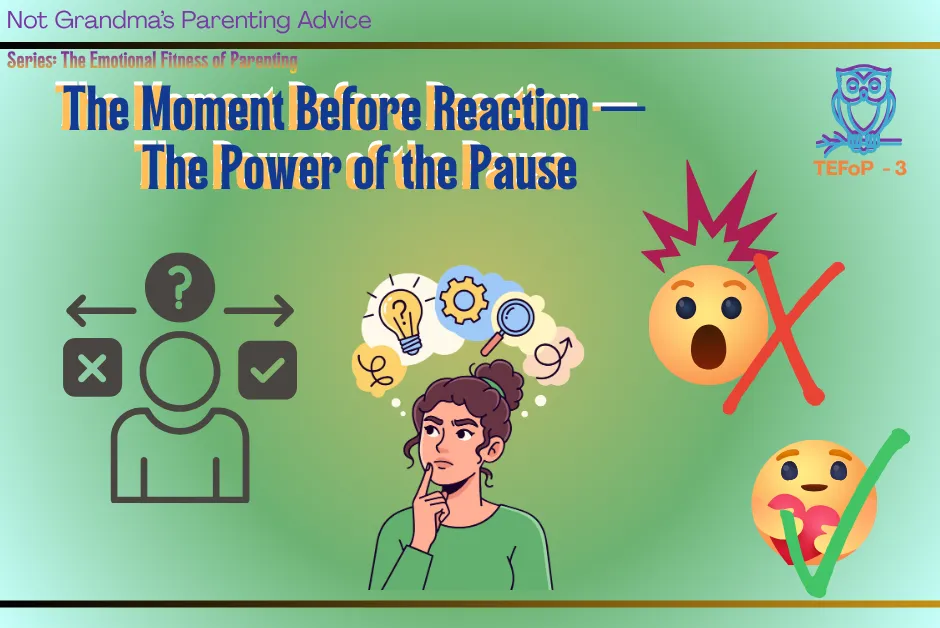
The Moment Before Reaction — The Power of the Pause
The Moment Before Reaction — The Power of the Pause
There is a moment in parenting that changes everything.
It’s small.
Often invisible.
Easy to miss.
But it’s where leadership lives.
It’s the moment before you react.
The moment most of us don’t realise exists
Your child says something sharp.
Ignores you.
Pushes a boundary.
And before you even think…
You’re already responding.
Tone shifts.
Body tightens.
Words come out.
Fast.
For many of us, especially when we’re tired or under pressure, this feels automatic.
Because it is.
That reaction isn’t a conscious choice.
It’s a pattern.
Why reaction happens so quickly
Our brains are wired to respond to perceived threat.
Disrespect.
Defiance.
Being ignored.
Even if those things aren’t actually what’s happening — they can feel like it.
So the body moves first.
Before logic.
Before intention.
Before the version of you that wants to lead differently has time to step in.
This is why you can know exactly what you want to do…
…and still not do it.
The pause — the smallest unit of leadership
The pause is not about being perfectly calm.
It’s about creating just enough space…
to choose a different response.
Sometimes that pause is only a second.
A breath.
A softening in your shoulders.
A decision not to speak immediately.
But in that moment, something powerful happens.
You interrupt the pattern.
From an Emotional Fitness perspective, this is where change begins.
Not in big, dramatic shifts.
But in small interruptions to what has always been automatic.
Why the pause feels so hard
If the pause is so powerful, why don’t we use it more?
Because the pause requires capacity.
And when your system is already stretched:
tired
overwhelmed
emotionally loaded
That space between trigger and response becomes very small.
Sometimes it disappears completely.
Which is why this work is not about forcing the pause.
It’s about building the capacity that makes the pause possible.
What happens without the pause
Without that moment of space, we tend to move into what relationship research calls a “harsh start-up”.
The correction comes out sharp.|
The tone carries frustration.
The message lands as criticism rather than guidance.
And even if the content of what we’re saying is reasonable…
The delivery creates resistance.
Children respond to tone before they respond to words.
So what we often get back is:
pushback
shutdown
escalation
Not because the child is the problem.
But because the interaction has already become charged.
What the pause makes possible
When you create even a small pause, your response shifts.
Instead of reacting, you can begin to lead.
This is where your VEC approach becomes available:
Validate
“I can see you’re frustrated…”
Empathise
“That makes sense, this is hard…”
Curiosity
“What’s going on for you right now?”
You’re still holding boundaries.
You’re still guiding behaviour.
But you’re doing it in a way that keeps the relationship intact.
And that changes everything.
The pause is not passive — it’s active leadership
It can sometimes feel like pausing means you’re “doing nothing”.
In reality, you’re doing something very deliberate.
You’re:
regulating your own response
choosing your tone
deciding how you want to show up
That is leadership.
Not control.
Not suppression.
Choice.
Building the pause (without pressure)
You don’t need to get this right every time.
In fact, you won’t.
This is a practice.
You might start with:
noticing after you’ve reacted
then catching it during
and eventually, just before
That progression matters.
Because each moment of awareness is building capacity.
Even when it feels messy.
When you miss the pause
You will still react sometimes.
That doesn’t undo the work.
It gives you another opportunity.
“I didn’t handle that the way I wanted to. Let’s try again.”
That repair teaches more than perfection ever could.
It shows your child:
that mistakes are part of being human
that relationships can recover
that emotional safety doesn’t disappear when things go wrong
A gentle reframe
Instead of asking:
“Why do I keep reacting like this?”
Try asking:
“Was there a moment I could have paused?”
And if the answer is no…
That’s not failure.
That’s feedback about your capacity.
This is where Emotional Fitness becomes visible
The pause is where Emotional Fitness moves from concept…
into action.
Not in perfect responses.
But in the growing space between trigger and reaction.
That space is where:
choice lives
leadership begins
and change becomes possible
A gentle next step
This week, don’t try to change everything.
Just begin to notice the moment.
The point where reaction starts.
Because the more you can see it…
The more possible it becomes to pause.
And that pause — even for a second —
is where a different way of parenting begins.
As always – Together we ARE Stronger
Regards
Leanne
The Motherhood Maven
Parenting Mentor | Emotional Fitness Consultant


