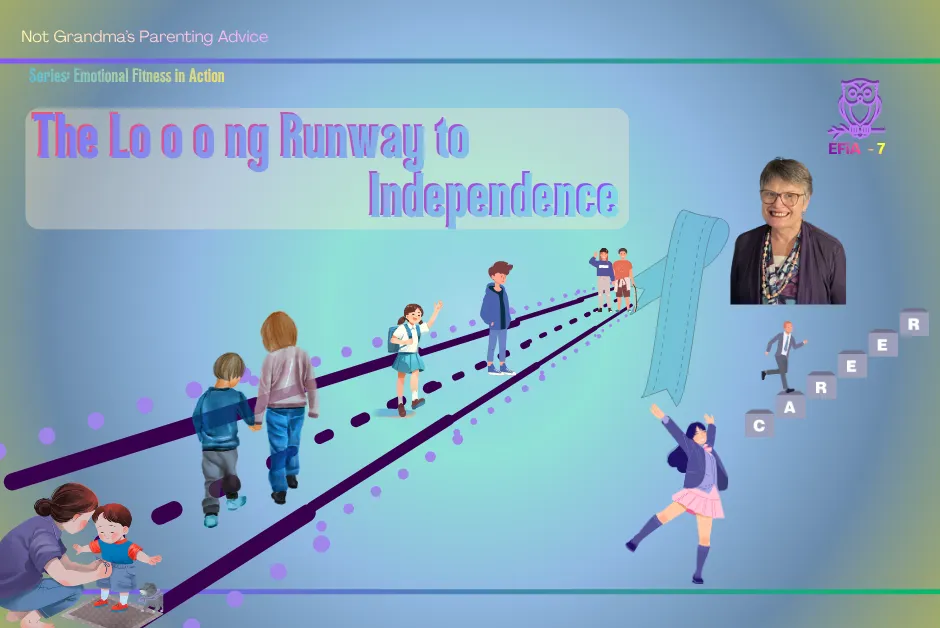
The Long Runway to Independence
The Long Runway to Independence
One of the easiest traps parents can fall into is expecting independence before capacity has caught up.
Children often look far more capable than they consistently are.
Especially through the tween and adolescent years.
They begin looking like young adults.
Sometimes they sound like young adults.
Occasionally they even make wonderfully mature decisions.
Then, seemingly out of nowhere, they make a choice that leaves us wondering:
“Were you even thinking?”
Most of us have asked that question at some point.
The answer is usually far more complicated than we realise.
Development Is Not Linear
One of the greatest misunderstandings about adolescence is that it’s “just hormones.”
Hormones certainly play a role.
But they are only one part of a much bigger developmental story.
Between roughly ten and thirteen years of age, the brain begins an important period of reorganisation.
Connections that are used frequently become stronger.
Others begin to be pruned away.
It’s a little like renovating a home while still trying to live in it.
The work being done is preparing the brain for greater efficiency and capability in adulthood.
But while that renovation is underway, there can temporarily be less capacity available for the very skills parents are expecting to see:
self-control
emotional regulation
organisation
planning
flexible thinking
Children haven’t suddenly forgotten everything they’ve learned.
Their brain is investing enormous energy in becoming something more capable in the future.
Capacity Before Consistency
One of the biggest shifts we can make as parents is recognising the difference between knowing and consistently doing.
A child may absolutely know the right thing to do.
An adolescent may genuinely agree with the family values you’ve spent years teaching.
Yet still struggle to consistently apply them.
That isn’t always defiance.
Sometimes it is development.
Sometimes it is emotional overwhelm.
Sometimes it is the slower maturation of executive functioning, particularly in many neurodivergent children.
Knowing better and having the capacity to consistently do better are not always the same thing.
That doesn’t remove accountability.
It changes how we understand it.
We Borrow Capacity Before We Build Our Own
Throughout childhood, our children borrow many things from us before they develop them independently.
They borrow our calm while they learn emotional regulation.
They borrow our perspective while they develop critical thinking.
They borrow our confidence while they build self-belief.
They borrow our emotional fitness before they develop their own.
Over time, our role gradually changes.
We move from directing…
to guiding…
to collaborating…
to standing beside them as they discover they can increasingly do it themselves.
This is one of the quiet miracles of parenting.
The Parent’s Journey
There is another developmental journey happening at the same time.
Ours.
One of the greatest tensions in parenting is living between two truths:
My child still needs me.
My child needs to learn to do this without me.
Sometimes, if we’re honest, there is another question sitting quietly underneath.
If they don’t need me in the same way anymore…
Who am I becoming?
That can feel confronting.
Especially for parents who have devoted years to caring, organising, anticipating and protecting.
But perhaps our role was never meant to stay the same.
Perhaps our role is meant to evolve as our children do.
Supporting Without Rescuing
One of the hardest skills for many parents to learn is staying emotionally available without stepping in too quickly.
We don’t abandon them.
Neither do we solve every problem for them.
Instead, we remain alongside them.
Sometimes simply listening.
Sometimes asking thoughtful questions.
Sometimes waiting until they’re ready.
And increasingly, especially through adolescence, seeking permission before stepping further into their thinking.
That might sound as simple as:
“Would you like me just to listen, or are you looking for ideas?”
“Can I share something I’ve noticed?”
“Would it help if we thought this through together?”
Permission doesn’t weaken our role as parents.
It strengthens the relationship.
It communicates respect.
It reminds our children that their thoughts, feelings and developing autonomy matter.
It also models one of life’s most valuable relationship skills.
Healthy adults don’t assume they know what’s best for everyone else.
They learn to collaborate.
They ask.
They listen.
They contribute without taking over.
Of course, there will still be times when we need to step in.
Safety will always take priority.
But when permission becomes part of everyday family life, those necessary interventions are far less likely to feel controlling or shaming.
Instead, they grow out of a relationship where children have experienced respect alongside guidance.
Ultimately, our goal isn’t to raise children who simply follow directions.
It’s to raise adults who know how to think, communicate, collaborate and respect the boundaries of others, just as they have learned to expect their own boundaries to be respected.
Temperament Shapes the Journey
Not every child travels this runway in the same way.
Some naturally test every boundary.
Others hold tightly to rules.
Some move towards challenge.
Others pause to observe before stepping forward.
Neither is better.
They are different ways of navigating the world.
Our role isn’t to force every child into the same mould.
It’s to understand the child we have and help them become the healthiest version of themselves.
Working with their temperament rather than constantly fighting against it.
The Long Game
One of the greatest privileges of parenting is watching the seeds we planted years earlier begin to emerge when our children are finally ready to use them.
Often long after we wondered whether they had heard a word we said.
Development is rarely obvious while it is happening.
Sometimes today’s frustration is quietly becoming tomorrow’s wisdom.
Sometimes the values we’ve modelled take years before they appear consistently in our children’s choices.
That doesn’t mean nothing has been happening.
Growth has simply been unfolding beneath the surface.
A Gentle Invitation
If you’re in the middle of the adolescent years, or navigating a season where your child seems to take one step forward and two steps back, take heart.
Development is rarely a straight line.
Your child is becoming.
And so are you.
Perhaps one of the greatest gifts we can give our children isn’t teaching them to have all the answers.
It’s helping them trust themselves to keep finding their way.
And maybe, along the way, we discover we can trust ourselves a little more too.
As always – Together we ARE Stronger
Regards
Leanne
The Motherhood Maven
Parenting Mentor | Emotional Fitness Consultant


