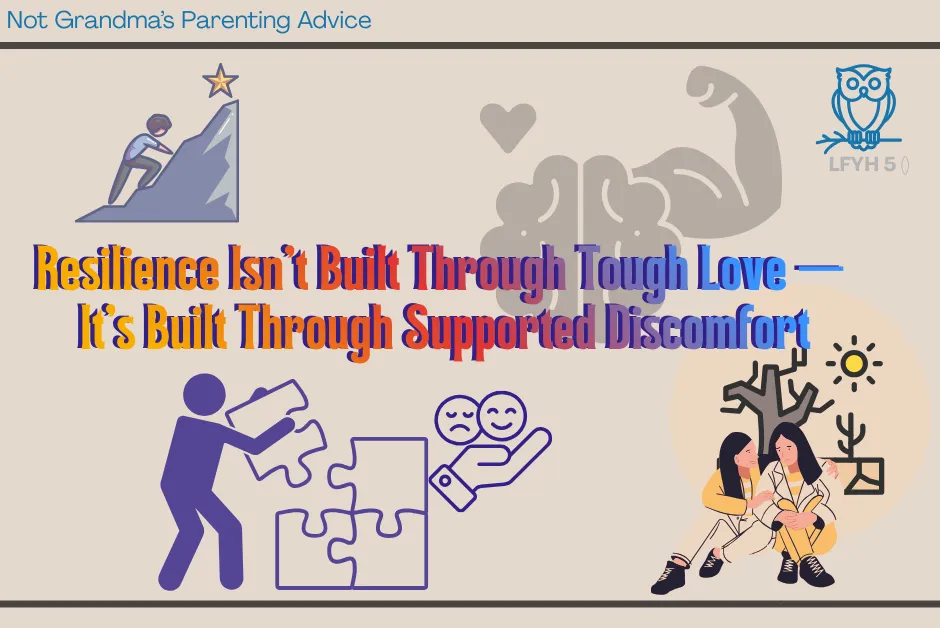
Resilience Isn’t Built Through Tough Love — It’s Built Through Supported Discomfort
Resilience Isn’t Built Through Tough Love — It’s Built Through Supported Discomfort
There’s a quiet tension many modern parents feel.
We don’t want to harden our children the way previous generations sometimes were hardened.
But we also don’t want to raise children who crumble at the first sign of difficulty.
So we sit in the middle, unsure.
Do we step in?
Do we let them struggle?
Do we protect?
Do we push?
Resilience doesn’t grow from extremes.
It grows from supported discomfort.
The myth of “tough love”
In older parenting models, resilience was often built through exposure.
“Life is hard.”
“You’ll get over it.”
“Don’t be so sensitive.”
Children were expected to endure.
Some did.
Some carried the strength forward.
Many also carried shame, silence, and emotional disconnection.
We’ve evolved.
We understand now that emotional safety matters.
That connection matters.
That children need validation and attunement.
But sometimes, in moving away from harshness, we drift toward overprotection.
Shielding children from disappointment.
Rescuing them from consequences.
Softening every uncomfortable edge.
Neither extreme builds resilience.
Real resilience requires two things
Author - Jim Collins in his book Good to Great shared an interview with Admiral James Stockdale, who was the highest-ranking United States military officer in the "Hanoi Hilton" prisoner-of-war camp during the Vietnam War. The response became known as the Stockdale Paradox:
To survive difficulty, we must hold two truths at once:
Maintain faith that we will prevail in the end.
Confront the brutal facts of our current reality.
Parenting requires the same balance.
We hold hope for our children.
And we allow them to experience reality.
Not harshly.
Not alone.
But honestly.
Resilience is not pretending things aren’t hard.
It’s knowing that hard things don’t break us — especially when we’re supported.
The role of the “circle of safety”
In leadership literature, Simon Sinek speaks about creating a “circle of safety” so that people can endure external challenges.
Families need this too.
When children know:
“I can come back here.”
“My feelings won’t be dismissed.”
“I won’t be shamed for struggling.”
They can face discomfort more bravely.
The goal isn’t to remove the challenge.
It’s to remain the safe harbour while they navigate it.
Letting children feel disappointment
Disappointment is not damage.
Frustration is not trauma.
Embarrassment is not failure.
These are normal human experiences.
And children need practice navigating them.
When we rush in to fix, soften, or solve every uncomfortable situation, we accidentally send a message:
“You can’t handle this.”
When instead we stay present and say:
“This feels hard, doesn’t it? I’m here.”
We send a different message:
“You’re strong enough — and you’re not alone.”
That combination builds resilience.
Strength without hardening
I once visited Toledo in Spain, where swords were historically forged.
To make the metal strong, it wasn’t left untouched.
It was placed in fire.
Beaten.
Folded.
And returned to the fire again.
The process wasn’t about destruction.
It was about refinement.
Children don’t need to be hardened by fire.
But they do need to discover that discomfort doesn’t destroy them.
With us nearby — steady, calm, supportive — they learn:
“I can feel this and survive it.”
“I can fail and try again.”
“I can be disappointed and still be okay.”
That is resilience.
Validation does not mean rescue
One of the most important distinctions in this work is this:
Validating feelings does not mean removing the difficulty.
You can say:
“That really hurt.”
“I can see you’re upset.”
“That didn’t go the way you hoped.”
Without fixing the situation.
Without criticising the other person.
Without taking control.
Leadership here means:
holding space
encouraging reflection
asking what’s in their control
and guiding them forward
Not shielding them from every storm.
The balance we’re learning
Leading the family you have means accepting:
Life will stretch your children.
Friendships will disappoint them.
Teachers will misunderstand them.
They will make mistakes.
Your role is not to prevent every stretch.
It’s to remain the steady place they return to.
Resilience grows where:
discomfort meets emotional safety.
That’s not tough love.
That’s conscious leadership.
If you sometimes wonder whether you’re doing too much — or not enough — you’re not alone.
Resilience isn’t built in a single moment.
It’s built over time, through gentle stretch and steady presence.
And that presence is far more powerful than perfection.
As always – Together we ARE Stronger
Regards
Leanne
The Motherhood Maven
Parenting Mentor | Emotional Fitness Consultant


