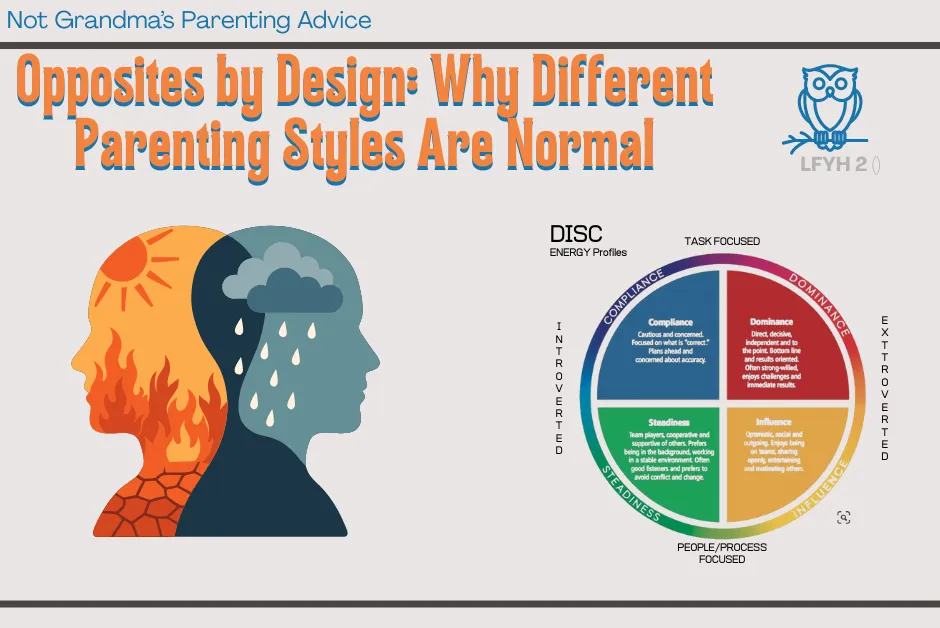
Opposites by Design Why different Parenting Styles are Normal
Opposites by Design: Why Different Parenting Styles Are Normal
One of the most common frustrations I hear from parents sounds something like this:
“We want the same thing for our kids — but we approach it completely differently.”
Often it’s said with exhaustion.
Sometimes with resentment.
Sometimes with a quiet sense of loneliness.
One parent is focused on structure and consistency. (and can come across a bit “my way or the highway”)
The other prioritises flexibility and responsiveness. (can come across a bit too fluffy to our partner who is then working to mitigate)
One steps in quickly. (which is fine when there is a real risk)
The other waits and watches. (which is fine when there is an opportunity of growth).
One worries about emotional impact. (the underlaying childhood “shark music” trap)
The other worries about resilience. (same challenge different perspective).
And somewhere along the way, difference starts to feel like a problem to be solved.
It isn’t.
Difference between parents is normal — not a flaw
Most couples aren’t randomly matched. It might seem like it, but our biology is programmed at it’s primordial level for intimate partnerships to seek a means of strengthening our bloodline.
We’re often drawn to people whose strengths complement our own — not mirror them.
The steady one partners with the intuitive one.
The planner partners with the improviser. (hello if you’ve not met my husband and I)
The protector partners with the challenger.
In calm seasons, these differences balance beautifully.
But under stress — and parenting is a long-term stressor — the differences amplify.
What once felt attractive can start to feel threatening.
And without meaning to, many parents begin trying to manage and mitigate each other
When “getting on the same page” becomes a trap
There’s a popular idea in parenting that partners must be “on the same page”.
It sounds reasonable.
Even responsible.
But taken too literally, it can create more harm than harmony.
Because “same page” often gets interpreted as:
same responses
same tone
same timing
same priorities
And when that doesn’t happen, frustration creeps in.
Especially for the parent who has done more reading, reflecting, or emotional labour.
At that point, difference starts to feel like:
being undermined
not being valued
not being listened to
And that’s usually when control sneaks in — quietly.
What’s often underneath the need for control
When one parent becomes highly invested in how others care for the children, it’s rarely about power.
It’s about fear.
Questions like:
What if my child is hurt emotionally?
What if they’re misunderstood?
What if I lose the progress I’ve worked so hard for?
What if my child feels safer with the other parent than with me?
These fears are deeply human — especially for the primary carer.
But the more we try to control how the world responds to our children, the smaller our influence actually becomes.
Control strains relationships.
Trust strengthens them.
Leadership is not sameness — it’s shared direction
Leading a family doesn’t mean parents must do things the same way.
It means they understand:
their own patterns
each other’s stress responses
where difference helps
and where alignment truly matters
You don’t need identical approaches to be on the same team.
You need:
shared values
agreed boundaries
and space for individual style
Children benefit from experiencing different ways of being with adults, as long as those differences sit inside emotional safety.
That’s not confusing.
It’s strengthening.
When neurodivergence is part of the picture
In families where ADHD or other forms of neurodivergence are present, polarity often feels sharper.
You may notice differences in:
processing speed
emotional intensity
tolerance for stimulation
follow-through
need for structure or autonomy
Neurodivergence doesn’t create these differences — it magnifies them.
Which is why awareness, not correction, is so important.
When adults misinterpret each other’s intent, tension escalates quickly.
When they understand patterns, leadership becomes possible again.
What children actually need from us
Children don’t need parents who always agree.
They need adults who can:
hold difference without hostility
repair when things go wrong
validate feelings without taking sides
separate behaviour from identity
and stay emotionally available, even when uncomfortable
Being a safe harbour doesn’t mean rescuing children from every difficult experience.
It means trusting their capacity — and staying present while they find their footing.
This is the work of Leading the Family You Have
The shift isn’t:
“How do I get my partner to do it my way?”
It’s:
“How do we lead this family together — with awareness, respect, and shared responsibility?”
Difference is not the enemy.
Misunderstanding is.
And leadership begins when we stop managing each other — and start leading with one another.
If this resonates, you’re not alone.
This is the work I guide parents through — helping them move from managing behaviour to leading through relationship, and from survival into shared direction.
As always – Together we ARE Stronger
Regards
Leanne
The Motherhood Maven
Parenting Mentor | Emotional Fitness Consultant


