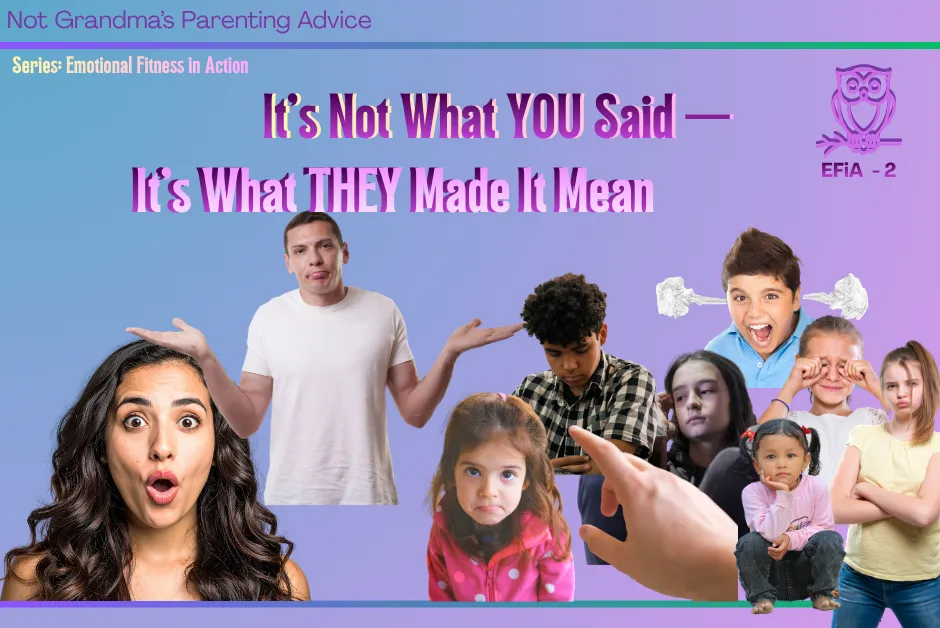
It’s Not What You Said — It’s What They Made It Mean
It’s Not What You Said — It’s What They Made It Mean
Have you ever walked away from a conversation with your child thinking:
“That wasn’t what I meant at all…”
You were calm.
Measured.
Intentional.
And somehow…
They still took it the wrong way.
Or, like some of us, our own “survival reaction” kicked in and we were who we didn’t want to be.
The Hidden Layer Most Parents Miss
We often focus first on:
what we said
how we said it
whether we stayed calm
And those things do matter.
But they’re not what your child carries forward.
What they carry is the meaning they made of the moment.
It’s why how we respond matters so much.
Not because we are responsible for our child’s thoughts or behaviours, but because we are responsible for helping them work through difficult moments safely enough to learn from them.
Children rarely learn through correction alone.
They learn when they feel safe enough to process what happened, understand themselves more clearly, and gradually do better over time.
And that takes practice.
Meaning Is Not Logical — It’s Emotional
Children don’t interpret situations the way adults do.
They don’t filter through:
intention
context
or long-term perspective
They interpret through:
feeling
experience
and their current capacity
So a simple correction might land as:
“I got it wrong again”
“I’m disappointing Mum”
“I can’t do this right”
Even when none of that was your intention.
Why This Matters More for Some Children
For children who:
feel deeply
are more sensitive
or are neurodivergent
…the gap between what was said and what was felt can be even wider.
Because their internal experience is often:
faster
more intense
and harder to organise
So they don’t just hear the words.
They absorb the feeling.
This Is Where Emotional Fitness Shows Up
Emotional fitness isn’t about controlling every outcome.
It’s about recognising:
“There’s a layer here I can’t see yet.”
And being willing to stay curious about it.
The Shift That Changes the Conversation
Instead of trying to perfect what you say…
the deeper shift is learning how to restore enough emotional safety that your child no longer feels they need to defend themselves from you.
Because when children feel threatened — whether by our reaction, their own shame, or simply knowing they’ve made a mistake — they are rarely in a place where reflective questions feel safe.
In that moment, even well-intended questions can feel like:
“I’m about to get this wrong again.”
Especially for children who already feel sensitive to correction, disappointment, or perceived failure.
This is where relationship basics matter most.
If we became reactive, frustrated, or emotionally flooded ourselves, then repair comes first.
Sometimes that sounds like:
“Whoops… that didn’t go so well.”
“I’m sorry I got upset.”
“I can see this got big for both of us.”
Not because we ignore the behaviour.
But because safety needs restoring before problem solving becomes possible.
And often, before we ask anything of the child, we may need to demonstrate understanding first.
Helping them feel seen before expecting reflection.
Something more like:
“I know you weren’t trying to upset me.”
“I can see you were focused on what felt important to you in that moment.”
“I know sometimes your brain moves faster than your brakes.”
For many impulsive or neurodivergent children, this is deeply regulating because it reduces the fear that they are the problem.
Only once enough safety returns does curiosity become useful.
Not interrogation.
But collaborative exploration.
This is where approaches like collaborative parenting align so strongly.
We are not simply trying to correct behaviour in the moment.
We are helping children gradually build the internal skills for:
reflection
emotional processing
problem solving
self-awareness
and repair in relationship
And many children cannot yet do this independently.
So we guide the process with them first.
((it’s developmental not intellectual)
Over time, through enough safe experiences, they begin developing the capacity to:
recognise their own patterns
tolerate uncomfortable feelings
and participate more actively in problem solving
Not because we lectured them into insight and reflection
But because we consistently modelled safety, curiosity, accountability, and repair.
And if we are transitioning into this style with older children, it’s important to appreciate that this process itself may be unfamiliar.
They may still expect defensiveness, correction, or shame.
So rather than demanding emotional maturity from them immediately…
we slow down.
Work collaboratively.
And model the process over time.
The Long Game
Over time, these small moments of:
checking in
clarifying meaning
and staying connected
help your child build:
a more accurate sense of themselves
greater emotional awareness
and stronger resilience
Not because life becomes easier.
But because they feel less alone in it.
A Gentle Invitation
If you’re noticing patterns where things feel misunderstood, repeated, or stuck…
there is another way to approach it.
And you don’t have to figure that out on your own.
Reach out when you’re ready.
As always – Together we ARE Stronger
Regards
Leanne
The Motherhood Maven
Parenting Mentor | Emotional Fitness Consultant


