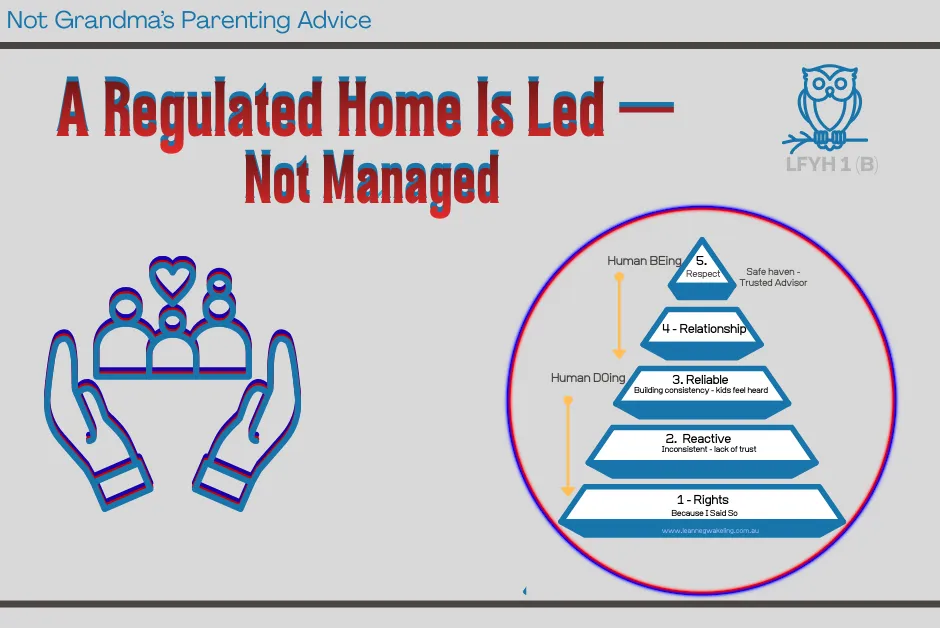
A Regulated Home is Led - Not Managed
A Regulated Home Is Led — Not Managed
A regulated and emotionally fit family doesn’t come from perfect parenting.
It comes from adults who can lead — collaboratively — even when they approach things differently.
Over the past weeks, we’ve been talking about regulated homes and resilient kids.
Understanding nervous systems.
Recognising behaviour as communication.
Reducing overwhelm.
Creating emotional safety.
For many parents, that shift alone has been deeply relieving.
Because when you stop seeing behaviour as defiance or failure, and start seeing it as information, something changes.
Perspective opens.
Blame softens.
Curiosity returns.
And then — almost inevitably — another question appears.
“If I’m the emotional north star in this family…
how do I stay steady when my partner parents differently to me?”
That’s not a parenting question.
That’s a leadership question.
Regulation is the foundation — not the finish line
A regulated home matters.
It’s essential.
But regulation on its own doesn’t carry a family forward.
Because families aren’t systems to be managed — though many of us fall into that trap, especially the more logistics-focused parent who keeps everything running.
Families are relationships to be led.
And leadership in families is relational before it’s instructional.
Children don’t just respond to what we say.
They adapt to what we model.
They’re watching:
how adults handle challenge
how conflict is navigated
whether repair is possible
how power is used (or misused)
how emotions are held — or avoided
This is where many parents quietly get stuck.
They’ve learned how to support their child —
but they haven’t been supported to understand how they and their partner function together.
Difference between parents is normal — not the problem
One of the most common sources of tension in families sounds like this:
“We want the same outcome — but we go about it in completely opposite ways.”
One parent prioritises structure.
The other prioritises flexibility.
One values consistency.
The other responds moment by moment.
One moves quickly.
The other needs time to process.
This isn’t dysfunction.
Its normal human difference — and especially common in intimate partnerships.
We’re often drawn to complementary strengths.
It’s part of how families balance, adapt, and survive.
The challenge is that under stress, these differences don’t soften — they amplify.
Without awareness, what was once complementary starts to feel like opposition.
That’s why self-understanding matters.
Frameworks like behavioural profiling (such as DISC), Human Design, or Positive Intelligence aren’t about labels — they’re about language.
They help us recognise patterns, understand our reactions, and reduce misinterpretation between adults.
When neurodivergence, such as ADHD, is part of the picture, these differences are often magnified — not created.
You might notice:
different processing speeds
different tolerance for stimulation
different needs for autonomy or structure
different emotional recovery times
ADHD doesn’t break families.
It reveals where understanding, leadership, and support are needed.
When leadership quietly turns into control
Under pressure, many well-intentioned parents slip into management mode.
More reminding.
More correcting.
More “just do it this way”.
Not because they want control —
but because they want things to work.
The trouble is, control increases resistance, not cooperation.
Leadership works differently.
Leadership:
makes space for difference
invites consultation rather than compliance
focuses on shared direction, not identical methods
Children learn far more from watching adults navigate difference than from any strategy we apply directly to them.
This is the shift we’re making now
This is where the work deepens.
We move from:
“How do I support my child?”
to:
“How do we lead this family — together — as the adults in it?”
Because children don’t need perfect parents.
They need adults who can:
lead with awareness
repair when things go wrong
adapt when life gets messy
Even when they don’t agree.
Even when they’re tired.
Even when they’re wired differently.
This next chapter is about Leading the Family You Have.
Not the family in the books.
Not the one you imagined.
The one you’re actually living inside.
And that leadership always starts with the adults.
If this resonates, you’re not alone.
This is the work I guide parents through — helping them move from managing behaviour to leading through relationship, and from survival into shared direction.
As always – Together we ARE Stronger
Regards
Leanne
The Motherhood Maven
Parenting Mentor | Emotional Fitness Consultant


