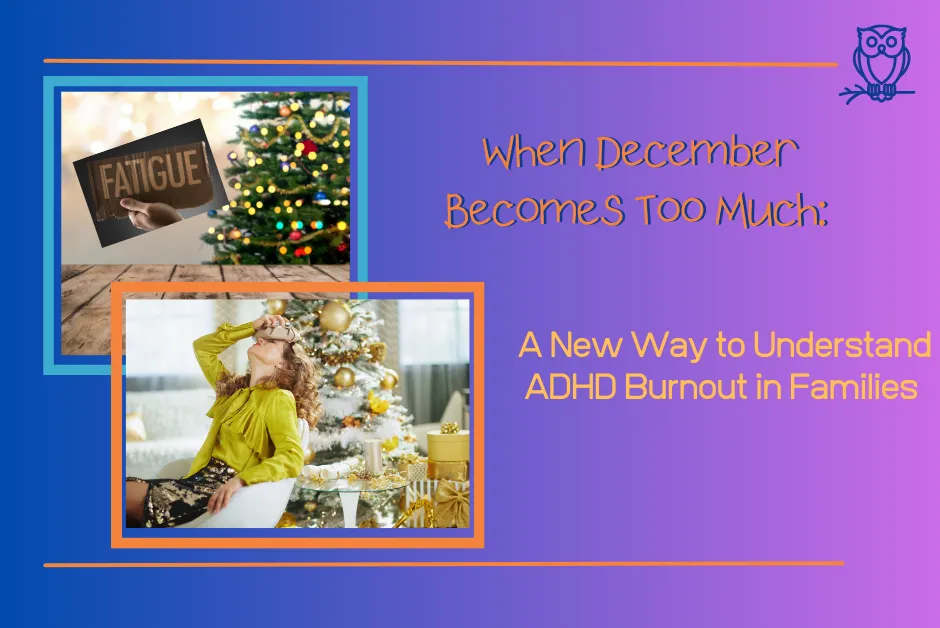
When December Becomes Too Much- A New Way to Understand ADHD Burnout in Families
The unspoken truth about December is this: it often breaks mothers before anyone else realises what’s happening.
Every year, right around the end of November, a slow swell begins – school concerts, end-of-year deadlines, presentations, teacher gifts, forgotten sign-ups, Christmas parties, social obligations, extended family politics, travel organisation, emotion-filled children, and everyone expecting Mum to hold the world together with grace.
For families touched by ADHD – whether the ADHD belongs to the child, the partner, or the mother herself – December creates a level of cognitive, emotional, and sensory overload that is almost impossible to communicate.
Traditional psychology might call this “stress” or “poor coping”.
But the lived truth is much deeper:
December is a perfect storm for ADHD burnout – and it lands hardest on the mother trying to manage everyone’s needs at once.
She is the project manager, emotional regulator, schedule-keeper, meltdown-soother, holiday planner, and tension-diffuser.
Some days, she feels like a circus ringmaster.
Other days, like she’s herding cats blindfolded.
And most days, like she’s failing – even though she’s the only reason anything is functioning at all.
Let’s explore why.
Why End-of-Year Burnout Hits Mothers in ADHD Families the Hardest
1. The mother carries the “invisible load” – amplified by ADHD
Even in the most equitable homes, mothers often hold the majority of the mental load:
remembering all the things
planning ahead
anticipating needs
managing the emotional climate
organising everyone’s lives
smoothing conflict
maintaining family traditions
preparing for extended family expectations
Now add ADHD into this mix.
In ADHD-impacted families:
routines are already fragile
executive function is already stretched
emotions are already intense
transitions already require extra support
sensory needs require careful navigation
December pours petrol on all of these.
A mother finds herself:
trying to keep all the balls in the air (work and home)
navigating end of year event excitement
worrying about extended family celebrations
being peacemaker (or attempting to)
trying to manage her own emotional bandwidth
compensating for her partner’s challenges and/or capacity
carrying the consequences when she forgets anything
This isn’t “poor planning”.
It’s an impossible cognitive load.
2. Traditional psychology focuses on behaviour. You’re focused on survival.
Old-school psychological models tend to ask questions like:
“How do we reduce the behaviour?”
“How do we increase compliance?”
“How do we reinforce positive action?”
Those frameworks are not built for December.
They overlook a crucial truth:
In December, everyone’s nervous system is saturated.
Children don’t need more behaviour plans.
Mothers don’t need more strategies.
Families need nervous system relief.
Behaviour isn’t the problem – it’s the signal.
The real problem is:
overstimulation
unpredictability
emotional pressure
cognitive overload
lack of capacity
too many transitions
not enough recovery time
This is why ADHD-impacted families experience burnout faster and more intensely than the average household.
3. The mother becomes the “default regulator” – for everyone
Mothers don’t just regulate their children. They end up trying to regulate:
the partner who’s overwhelmed
the child who’s melting down
the neurodivergent teen who shuts down
the extended family who “doesn’t get it”
the teachers asking for “just one more thing”
the relatives who judge their parenting
the internal voice insisting they “should” be doing more
She becomes:
the negotiator
the buffer
the planner
the emotional sponge
the protector
the narrator
the coach
the therapist
the peacekeeper
And yet – she is often the most unsupported person in the home.
Not because others don’t care, but because she is the only one who sees all the moving parts.
She is the one keeping the system from collapsing.
This is why she often breaks first.
Why ADHD Children “Fall Apart” in December (and what mothers are actually managing)
Neurodivergent children don’t struggle in December because they’re difficult.
They struggle because their nervous system simply cannot maintain stability under:
unpredictable routines
constant transitions
increased sensory load
social pressure
family expectations
emotional contagion (everyone else’s stress)
lack of quiet time
the expectation to “be happy”
An ADHD brain tends to experience:
More intense stimulation
Noise, lights, smells, crowds, excitement – all land louder and stronger.
Faster overwhelm
Bandwidth drains far more quickly.
Harder transitions
Switching tasks, shifting environments, adapting to change requires more effort.
Stronger emotional reactivity
Big feelings erupt quickly and intensely.
Reduced inhibition
Thoughts and feelings are closer to the surface and spill out more easily.
Difficulty expressing internal states
So behaviour communicates what words cannot.
When this happens, mothers often find themselves needing to:
maintain connection when behaviour is hard to like
reduce shame when everyone else is judging
co-regulate in the middle of chaos
repair misunderstandings
prevent escalation
protect the child from criticism or disbelief
advocate relentlessly for their needs
This is care.
This is labour.
This is emotional work few people see – and even fewer acknowledge.
When the ADHD Parent Also Struggles – a quiet dual-burnout
Many mothers themselves are neurodivergent – formally diagnosed, self-identified, or completely unaware but deeply affected.
December hits these mums doubly hard because:
their executive function is already stretched
emotional regulation takes energy they don’t have
working memory collapses under pressure
organisation feels impossible
they’re masking to appear “together”
they’re navigating old shame stories
their sensory system is already saturated
they automatically assume responsibility for everyone
The ADHD mother often collapses internally long before anyone can see the signs externally.
This is why she needs support – not more “solutions”.
Nourishment, not judgement.
Anchoring, not perfectionism.
The Psychology Gap: What Traditional Approaches Miss
Traditional behavioural approaches often focus on:
rewards
consequences
consistency
control
compliance
But this lens misses some critical realities:
The biological reality of neurodivergent nervous systems
ADHD is not simply a behaviour issue – it’s a regulation difference.
The role of the environment
December is dysregulating even for neurotypical families. For ADHD families, it’s like turning the volume up to eleven.
The emotional labour of the mother
She is the nervous system anchor – but anchors need to be secured and cared for too.
The mismatch between expectations and human capacity
Children cannot be “regulated” into compliance when they’re already overwhelmed.
The role of generational patterns
Many mothers learnt to mask, suppress, or perform emotional strength. Asking for help can feel unsafe or shameful, even when they desperately need it.
The role of shame
ADHD is often accompanied by an internalised story of “not good enough” that resurfaces intensely during high-pressure seasons like the holidays.
I see it differently:
Families don’t need to be fixed.
Nervous systems need to be understood.
And mothers need to be supported.
This is emotional fitness – not behaviour management.
What ADHD Families Actually Need in December
So if behaviour charts and “better routines” aren’t the answer, what is?
Here’s what tends to make a genuine difference:
1. Less expectation, more connection
No child will remember a perfect Christmas.
They will remember feeling safe, seen, and accepted.
When in doubt, ask:
“Does this protect connection or threaten it?”
2. Simple routines, predictable rhythm
I’m not talking about rigid structure.
I’m talking about gentle anchoring points:
similar wake and sleep times (as much as possible)
predictable “quiet” time
space between big activities
a sense of “what’s coming next”
These small elements help soothe the nervous system.
3. Permission to lower the bar
You are allowed to:
skip events
leave early
say no to hosting
choose easier food options
not do all the “extras”
Not every invitation requires a yes.
Not every idea needs to be implemented this year.
4. Emotional cushioning
December can be softened by:
slower transitions
extra preparation time
clearer, simpler instructions
co-regulation before correction
more “I’m here with you” and fewer long explanations
Think of it as building soft landings instead of hard expectations.
5. Space for the mother to breathe
You cannot co-regulate if you have nothing left in your own tank.
That might mean:
time alone in a quiet room
a walk around the block
a shorter to-do list
fewer people staying in your home
asking for help (even when it feels uncomfortable)
You matter too.
6. Release from the “magic-maker” role
There is so much pressure on mothers to make Christmas “magical”.
But that pressure often destroys your own capacity to experience any joy at all.
You don’t have to be the magic.
You simply need to be present enough to be yourself.
This Season Isn’t for Transformation – It’s for Survival With Grace
If you are an overwhelmed mother reading this, please exhale.
You do not need to:
be the festive coordinator
manufacture memories
manage everyone’s feelings
hide your exhaustion
run the emotional show
pretend you’re coping when you’re fraying
take on another complex parenting framework
“self-improve” during burnout season
That is not what this season is for.
December is not a growth season.
It is a capacity season.
A season of gentle responsiveness.
A season of self-preservation.
A season of permission.
This is why I don’t open my deeper programs until February.
Right now, you don’t need a curriculum.
You need someone to sit beside you, steady the chaos, and help you breathe again.
Introducing the “Soft Landing” Season (Dec–Jan)
For December and January, my focus is on supporting you – the mother.
That looks like:
gentle emotional anchoring, not pressure
practical strategies to reduce overwhelm (nervous system maps, not behaviour charts)
compassionate reminders that you are enough, especially when you feel anything but
light-touch support until you have capacity for deeper work – no homework, no assignments, no big commitments
a place (and a voice) where you feel understood rather than judged
This is your soft landing –
so when February arrives, you begin from strength, not exhaustion.
For now, let this be your permission slip
You are not behind.
You are not failing.
You are not weak.
You are carrying a load no one else fully sees.
And you are doing it far more beautifully than you realise.
The work ahead is not about fixing your family.
It’s about understanding your nervous system, your patterns, your needs, your rhythms – and allowing yourself to receive support rather than always being the one who provides it.
Because:
Regulated homes create resilient kids — and the most important nervous system in the home is yours.
Together we ARE Stronger.
With care,
Leanne
The Motherhood Maven
Parenting Mentor | Emotional Fitness Consultant


